
Recruitment has changed. Businesses are no longer looking only for candidates who match a job description. They want professionals who have relevant skills, understand their industry, communicate effectively and can contribute to the organisation. Recruiters also face a growing operational challenge. They use professional networking platforms to discover candidates, separate tools to manage applications, messaging platforms to communicate and other systems to coordinate hiring activities.
This raises an important question: Does your business need another recruitment tool, or does it need a more connected professional ecosystem?
In this comparison, we explore Lobox Recruiter vs LinkedIn Recruiter, their different approaches to recruitment and what businesses should consider before choosing a hiring platform.
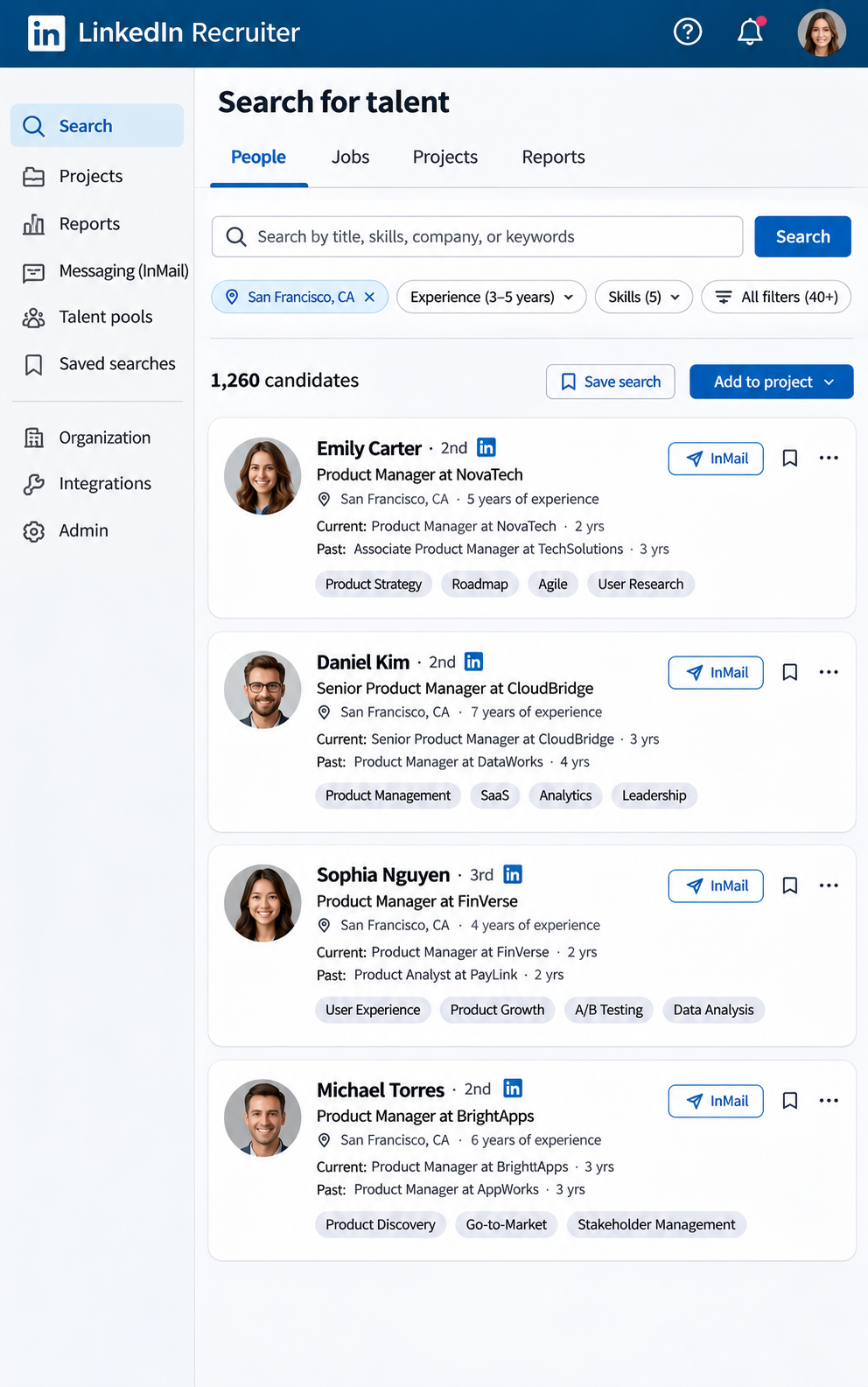
Some of its key capabilities include:
1.Advanced candidate search: Search using skills, job titles, experience, location and other filters.
2.InMail messaging: Contact professionals who are not directly connected to the recruiter.
3.Candidate recommendations: Discover potential candidates based on hiring requirements.
4.Recruitment collaboration: Share projects, candidate information and notes with hiring teams.
5.ATS integrations: Connect with supported applicant tracking systems.
6.Recruitment analytics: Monitor recruiting activity and pipeline performance.
LinkedIn Recruiter offers access to its wider professional network, 40+ advanced search filters and 150 InMail credits per month per seat in its standard Recruiter offering. Features differ across Recruiter plans. For businesses that depend heavily on professional sourcing, LinkedIn Recruiter can be a valuable recruitment solution. However, its primary focus is recruitment and talent sourcing within the LinkedIn ecosystem.
What is LinkedIn Recruiter?
It is particularly useful for organisations that need to source candidates from a large professional network.
Some of its key capabilities include:
1.Advanced candidate search: Search using skills, job titles, experience, location and other filters.
2.InMail messaging: Contact professionals who are not directly connected to the recruiter.
3.Candidate recommendations: Discover potential candidates based on hiring requirements.
4.Recruitment collaboration: Share projects, candidate information and notes with hiring teams.
5.ATS integrations: Connect with supported applicant tracking systems.
6.Recruitment analytics: Monitor recruiting activity and pipeline performance.
LinkedIn Recruiter offers access to its wider professional network, 40+ advanced search filters and 150 InMail credits per month per seat in its standard Recruiter offering. Features differ across Recruiter plans. For businesses that depend heavily on professional sourcing, LinkedIn Recruiter can be a valuable recruitment solution. However, its primary focus is recruitment and talent sourcing within the LinkedIn ecosystem.
What is Lobox Recruiter?
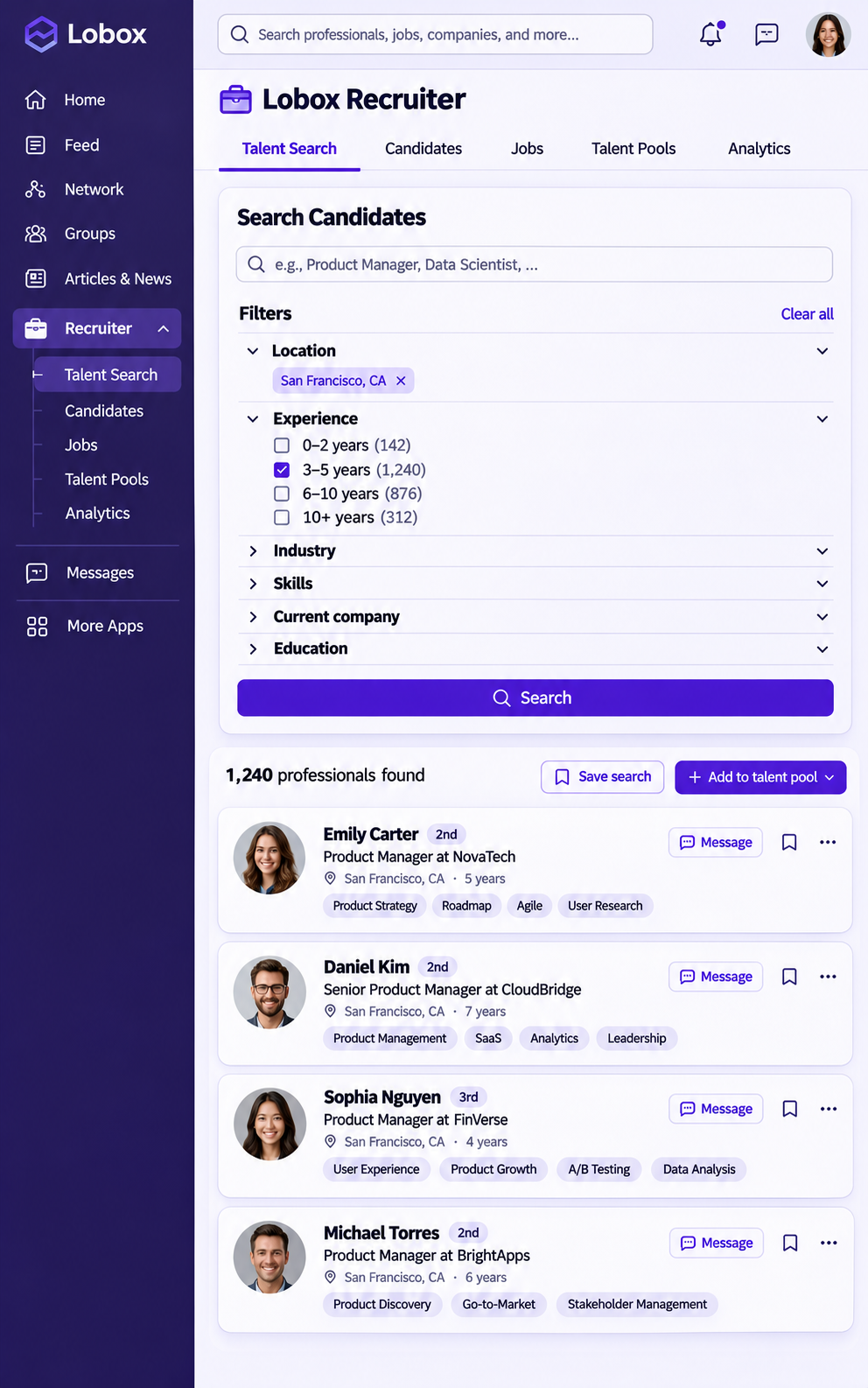
Lobox Recruiter is the recruitment component of Lobox, a broader professional social platform. Unlike a standalone recruitment product, Lobox is designed around a connected ecosystem that brings multiple professional activities together.
Its platform includes:
• Feed: Discover and engage with professional content.
• Discovery: Explore professionals and relevant opportunities.
• Messenger: Communicate with other professionals.
• Recruiter: Access recruitment-related business workflows.
• Profile: Build a professional presence.
• Articles and News: Stay informed about industry developments.
• Groups: Participate in professional communities.
The idea is straightforward: professional networking and recruitment should not have to operate as completely separate experiences. For businesses, this creates an opportunity to connect their hiring activities with a wider professional environment. For candidates, it offers more than a place to submit job applications. They can also participate in professional discussions, build their profiles and engage with communities.
5 Key Differences Between Lobox Recruiter and LinkedIn Recruiter
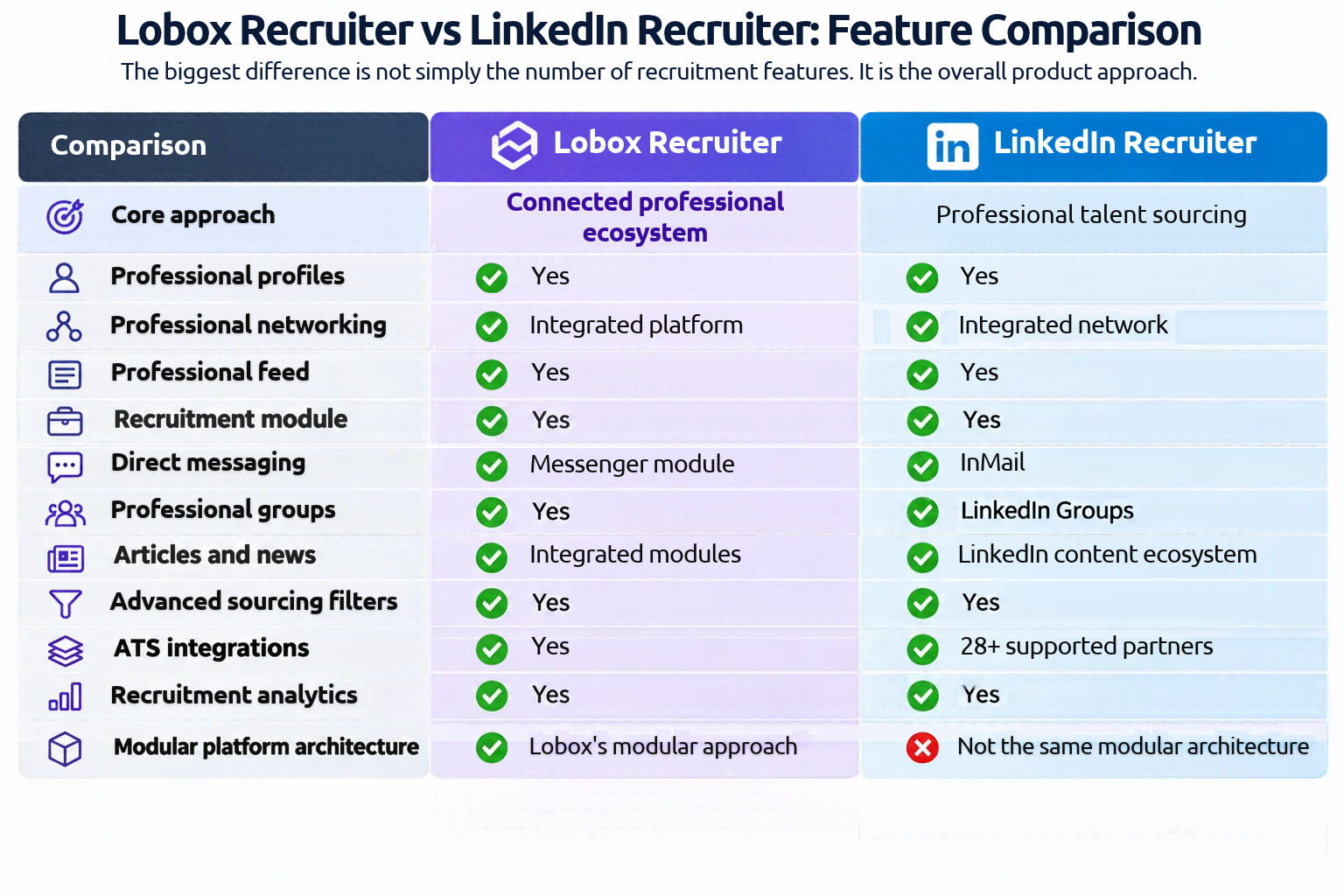
1. Recruitment vs a broader professional ecosystem
LinkedIn Recruiter is designed primarily to help organisations source, contact and manage potential candidates.
Lobox takes a broader approach. Its Recruiter module exists within a platform that also includes professional networking, content discovery, messaging and communities. This distinction matters because recruitment does not begin when someone submits an application. It can start much earlier, through professional interactions, industry discussions and community participation.
2. Professional engagement beyond job applications
A candidate's professional identity is more than a CV.
Their interests, industry knowledge, professional contributions and participation in relevant communities can provide additional context.
Lobox brings these professional activities into the same ecosystem as its recruitment module.
LinkedIn also supports professional content and networking. Its advantage is the scale and maturity of its established professional network.
The opportunity for Lobox is to make these experiences work together through its modular platform.
3. Connected communication
Recruiters regularly communicate with candidates during different stages of hiring. Using separate communication tools can create fragmented conversations and additional coordination work.
Lobox includes Messenger as a platform module, alongside Recruiter.
LinkedIn Recruiter provides InMail and recruitment collaboration features, with messaging capabilities that vary by subscription.
The practical comparison should focus on how easily recruiters can move from discovering a professional to communicating and managing the next hiring step.
4. One platform instead of multiple professional tools
Consider a typical recruitment workflow:
1. A recruiter discovers a professional.
2. They review the person's profile.
3. They contact the candidate.
4. They discuss an opportunity.
5. They share relevant information with the hiring team.
When these activities happen across disconnected products, recruiters have to switch between platforms. Lobox's broader ecosystem is designed to bring professional discovery, communication and recruitment into one environment. This is an important product differentiation, although businesses should still evaluate whether they need a separate ATS or other integrations for their existing hiring processes.
5. Modular platform experience
One of Lobox's architectural differentiators is its modular design.
Instead of treating every platform feature as one fixed experience, Lobox is built around modules that users can enable or disable according to their requirements. This gives the platform flexibility to support different professional use cases.
For example, a professional may prioritise Feed, Discovery and Groups, while a business may place greater emphasis on Recruiter and professional profiles. This modular approach is different from purchasing a standalone recruiting subscription.
Why Are Businesses Looking Beyond Traditional Recruitment Tools?
Recruitment technology has improved significantly, but having more software does not automatically make hiring easier.
Businesses often face three operational problems.
1. Tool fragmentation
Recruiters may use different systems for sourcing, applicant tracking, communication and employer branding. This creates additional coordination work.
2. Limited candidate context
A CV provides information about experience and qualifications, but it may not capture a person's wider professional participation.
3. Increasing software complexity
Every additional platform introduces another login, workflow, subscription and learning requirement.
The goal should not be to eliminate every specialist tool. Some businesses genuinely need advanced ATS functionality and integrations. The better objective is to reduce unnecessary fragmentation without sacrificing essential recruitment capabilities.
For further reading, explore:
• SHRM for HR management and talent acquisition resources.
• Harvard Business Review for research and insights on workplace management.
• Gartner HR Research for HR technology and workforce research.
Which Platform Should Your Business Choose?
There is no universal winner. The right choice depends on your recruitment requirements.
Choose LinkedIn Recruiter if:
• Your hiring strategy depends heavily on sourcing from LinkedIn.
• You need advanced candidate search and filtering.
• You regularly recruit passive candidates.
• Your team needs established recruitment collaboration and ATS integrations.
• Access to LinkedIn's professional network is a major priority.
Consider Lobox if:
• You want professional networking and recruitment in one ecosystem.
• Your business values integrated professional communication.
• You want a platform that combines Feed, Discovery, Groups and Recruiter.
• You prefer a modular professional platform rather than a recruitment-only experience.
• You want to explore an alternative approach to professional engagement and hiring.
For businesses with complex hiring operations, evaluate the actual Recruiter workflow, candidate management capabilities and ATS requirements before replacing existing systems.
The Future of Recruitment Is More Connected
Recruitment is not just about finding someone who matches a job description. It is also about building professional relationships, understanding candidates and creating meaningful connections between businesses and talent.
LinkedIn Recruiter has established itself as a powerful talent sourcing solution. Its network scale, advanced search and recruitment infrastructure make it a strong choice for many organisations.
Lobox approaches the problem from a different direction. Rather than focusing exclusively on recruitment, it brings professional networking, communication, content and hiring into one ecosystem.
The difference is simple: LinkedIn Recruiter focuses on talent sourcing, while Lobox aims to connect recruitment with the wider professional experience. Explore Lobox and discover a more connected approach to professional networking and hiring.
Frequently Asked Questions
1. What is the difference between Lobox Recruiter and LinkedIn Recruiter?
LinkedIn Recruiter focuses on talent sourcing, candidate outreach and recruitment workflows. Lobox Recruiter is part of a broader professional ecosystem that combines recruitment with networking, messaging, content and communities.
2. Is Lobox an alternative to LinkedIn Recruiter?
Lobox offers an alternative approach to professional networking and recruitment. Whether it can replace LinkedIn Recruiter depends on the business's sourcing, candidate management and integration requirements.
3. Is LinkedIn Recruiter suitable for small businesses?
LinkedIn offers Recruiter Lite for individuals and smaller businesses with lower-volume hiring needs. Its full Recruiter solution is designed for more extensive recruitment requirements.
4. Can businesses use Lobox for professional networking and recruitment?
Yes. Lobox is designed to bring professional networking and recruitment together through modules such as Feed, Discovery, Messenger, Profile and Recruiter.
5. Why are businesses exploring integrated recruitment platforms?
Businesses are looking for ways to reduce disconnected workflows, simplify professional communication and bring more of their hiring-related activities into connected environments