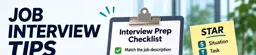

The best tip for a job interview is simple: prepare for this specific job, not for interviews in general. Match your experience to the job description, research the company, practice your answers out loud, bring two or three sharp questions, and follow up within a day.
That's the short version. Below is a prep plan you can follow from a week out to the thank-you email, with templates for your answers, your questions and your follow-up.
Job interview tips at a glance

How to prepare for a job interview
Start about a week out. Break the job description into the 4 or 5 things the employer needs most, find a real example from your work for each one, and research the company and the people interviewing you. Then practise your answers out loud until you can give each one in about two minutes.
Here's how to do each step properly.
1. Turn the job description into a checklist
Print the posting or paste it into a doc. Highlight every skill, tool, responsibility and outcome it mentions. Then pick the five that appear most often or sit near the top. Those are what the interviewer will probe.
Next to each one, write your proof.
A simple table works:

If a row stays empty, that's a gap the interviewer may notice too. Prepare an honest answer that shows how you'd close it, such as a related skill or how fast you learned something similar.
2. Research the company beyond the homepage
The About page tells you what the company wants you to think. Go further:
- Recent news and announcements. A product launch, funding, a new office or a leadership change gives you something real to mention.
- The product or service itself. Use it if you can. Read customer reviews to see what people praise and complain about.
- The team. Look at who works in the department you'd join and what they post about.
- Your interviewers. Check their role, how long they've been there and what they've worked on. This helps you pitch answers at the right level.
Professional networks are useful here. Looking up your interviewers and future teammates on Lobox or similar platforms shows you their background, and sometimes a mutual connection you can ask about the team before the interview.
3. Know your resume cold
Anything on your resume is fair game. Reread it the way a skeptical stranger would. For every bullet, be ready to explain what you did, how you did it and what happened as a result.
If you tailored your resume for this role, bring that version, not your generic one. The interviewer has it in front of them.
4. Build 5 or 6 stories using the STAR method
Most interviews include behavioral questions: "Tell me about a time you...". The STAR method keeps your answer structured and short:
- Situation: the context, in one or two sentences
- Task: what you were responsible for
- Action: what you did (say "I", not "we")
- Result: what changed, with a number if you have one
Prepare stories that cover a success, a failure or mistake, a conflict with a colleague, a time you led something, a time you handled pressure, and a time you learned something fast. One good story can answer several questions.
Sample STAR answer (question: "Tell me about a time you solved a problem under pressure.")
"Two weeks before a client launch, our support queue doubled because of a billing bug (Situation). I was the support lead, so I had to keep response times down without extra staff (Task). I wrote three saved replies for the most common tickets, moved two people from email to live chat during peak hours, and set up a daily 10-minute check-in with engineering on the fix (Action). We cleared the backlog in four days and the client launched on time (Result)."
That's about 30 seconds spoken. Aim for answers between one and two minutes.
5. Prepare for the questions you'll almost certainly get
You can't predict every question, but these come up in most interviews:
- Tell me about yourself.
- Why do you want this job?
- Why do you want to work here?
- What are your strengths? What's a weakness?
- Why are you leaving your current job?
- Tell me about a challenge or conflict and how you handled it.
- What are your salary expectations?
- Do you have any questions for us?
"Tell me about yourself" formula: present, past, future
- Present: your current role and the one thing you're best at.
- Past: one or two experiences that led you here and fit this job.
- Future: why this role is the logical next step.
"I'm a marketing coordinator at a regional healthcare group, where I run our email program and event campaigns. Before that I spent two years in a sales support role, which is where I learned to write for people who skim. I'm applying for this role because I want to own the full campaign, not just execution, and your team's focus on lifecycle email is exactly where I want to grow."
Keep it under 90 seconds. It's an opening, not your life story.
If you're changing careers, expect "Why the switch?" Answer with what's pulling you toward the new field, not what's pushing you out of the old one, and connect the skills you're bringing across.
6. Practise out loud
Reading your notes is not practice. Say the answers out loud, time them, and record at least a few. You'll hear filler words, rambling openings and endings that trail off.
If you can, do a mock interview with a friend, a mentor or someone working in the field. Ask them to interrupt with follow-up questions, because real interviewers will.
Interview tips for the day before
Use this checklist so nothing small trips you up:
- Confirm the time, time zone, format and the names of everyone interviewing you
- Plan your route and leave time for delays, or test your camera, mic, internet and the video platform link
- Choose your outfit. Match or go slightly above what the team wears day to day
- Print 2 or 3 copies of your resume and bring a notepad and pen
- Write your questions for the interviewer on one page
- Reread the job description and your proof table one last time
- Get a proper night's sleep instead of cramming
Interview tips for interviewees: during the interview
In the room, your job is to make it easy for the interviewer to say yes. Arrive a little early, give focused answers backed by examples, ask thoughtful questions, and close by restating why you fit. Most interview tips for the interviewee come back to one thing: be specific, not impressive-sounding.
The first few minutes
First impressions form fast. Be on time (10 to 15 minutes early in person, 2 to 3 minutes early online), greet everyone by name, and have a light answer ready for small talk. Sit up, keep your phone away and look at the person speaking.
Answer the question that was asked, then stop
Nervous candidates keep talking after they've made their point. Give your answer, add one example, and stop. If the interviewer wants more, they'll ask. It's fine to take a few seconds to think before you answer.
When you don't know the answer
Don't bluff. Say what you do know, explain how you'd find the rest, or connect it to something similar you've done. "I haven't used that tool, but I learned Asana in my first week at my last job by building our team's project board" is a strong answer.
When salary comes up
Research Your Salary Expectations Before the Interview
Research the salary range before your interview. Check whether the job posting mentions compensation, compare salaries in similar job listings, and consider your experience, skills, industry, and location.
For US-based roles, use the BLS Occupational Outlook Handbook to research typical pay by occupation.
If the interviewer asks about your expectations early, you can say:
"I'm looking for a salary in the range of X to Y, based on the role, market rates, and my experience. However, I'd like to understand the full scope of the position before discussing a final figure."
Questions to ask the interviewer
Always have questions ready. Good ones show you're thinking about doing the job, not just getting it:
- What would success look like in the first 90 days?
- What's the biggest challenge the person in this role will face?
- How does this team work with [another department named in the posting]?
- What do you enjoy most about working here?
- What are the next steps in the process, and when should I expect to hear back?
Save questions about vacation, remote days and perks for the offer stage, unless the interviewer raises them.
Close the interview clearly
Before you leave, sum up your fit in two sentences and confirm next steps:
"Thanks, this was really helpful. From what you've described, the client onboarding work is a close match to what I've been doing for two years, and I'd be glad to bring that here. What's the timeline for next steps?"
How to stand out in a job interview
You stand out by being the candidate who already understands the job. Bring a specific observation about the company, tie every answer to their needs, show how you'd approach the first few months, and send a follow-up that adds something. Most candidates are prepared. Few are this specific.
A few ways to do it:
- Bring one useful observation. Something you noticed using their product, reading their reviews or following their news. Phrase it as curiosity, not criticism.
- Sketch a first-90-days plan. Not a slide deck. Three or four points on what you'd learn, who you'd meet and what you'd try to improve. Offer it when they ask about the role or how you'd approach it.
- Use their language. If the posting says "customers", don't say "clients". Small, but it shows you listened.
- Show work where it fits. A portfolio piece, a writing sample or a short case from a past role makes your claims easy to believe.
- Be likeable and honest. Interviewers are also asking whether they want to work with you every day.
Tips for video, phone and panel interviews

After the interview: follow up
Send a thank-you email within 24 hours. Keep it short, mention something specific from the conversation, and restate your interest. Here's a template:
Subject: Thank you, [Job title] interview
Hi [Name],
Thank you for taking the time to talk with me today about the [job title] role. I enjoyed hearing about [specific project or challenge they mentioned], and it made me even more interested in the position.
Our conversation confirmed that my experience with [relevant skill or result] would help with [their need]. Please let me know if I can share anything else.
Best regards, [Your name] [Phone] | [Profile link]
If you met several people, send each a short, slightly different note. If the date they gave for a decision passes, one polite follow-up a few days later is fine.
Whatever happens, write down the questions you were asked and how you answered. It makes your next interview easier.
Common job interview mistakes to avoid
- Showing up without knowing what the company does
- Criticizing a current or former employer
- Giving "we" answers that hide what you personally did
- Rambling past the two-minute mark
- Having no questions at the end
- Inventing experience you don't have
- Forgetting to follow up
Find your next interview on Lobox
Preparation gets you through the interview. Getting more interviews starts with being visible to the right people. Find jobs on Lobox and connect with recruiters and professionals in your field, so your next interview starts with a conversation, not a cold application.
4. FAQ
What are the most important tips for a job interview?
Research the company and the role, match your experience to the job description, and prepare short examples using the STAR method. Practise your answers out loud, arrive a little early, ask two or three thoughtful questions, and send a thank-you email within 24 hours. Specific preparation beats general confidence every time.
How long should I prepare for a job interview?
For most roles, spread your preparation over 3 to 7 days. Spend the first days on research and matching your experience to the job description, then write your STAR stories, then practise out loud. If the interview is tomorrow, focus on the job description, three strong stories, "tell me about yourself" and your questions for them.
What should I say at the start of a job interview?
Greet each person by name, thank them for their time and keep small talk light and friendly. When they ask you to introduce yourself, use a 60 to 90 second answer covering your current role, the experience that led you here and why this job is your logical next step. Avoid reciting your whole resume.
What should you not say in a job interview?
Avoid criticizing past employers or colleagues, claiming you have no weaknesses, or asking about time off and perks before an offer. Don't make up experience, and don't say "I don't have any questions" at the end. Vague answers without examples also hurt you, because the interviewer has nothing concrete to remember.
How do I calm my nerves before an interview?
Most nerves come from not knowing what to expect, so preparation is the best fix. Practise your answers out loud until they feel familiar, sort out logistics the day before and arrive early. Just before the interview, take a few slow breaths and remind yourself that a pause to think before answering is completely normal.
How soon should I send a thank-you email after an interview?
Send it within 24 hours, ideally the same day. Keep it to a few sentences: thank them, mention something specific you discussed and restate why you're interested. If you met several interviewers, send each a short personalized note. Then wait for the timeline they gave before following up again.