
An accountant records, checks and explains an organization's money. In practice, that means recording transactions, reconciling accounts, closing the books each month, preparing financial statements and tax returns, and telling managers what the numbers mean for their decisions.
So what does an accountant do on an ordinary Tuesday? It depends on the type of accountant, the employer and the time of year. This guide covers the daily work, the main types, how duties change as you move up, and a simple way to tell whether the job would suit you.
What does an accountant do day to day?
Most accountants spend their days in spreadsheets and accounting software, matching records against bank statements and invoices, fixing differences, posting journal entries and preparing reports. They also answer questions from managers, clients or auditors. The exact mix depends on whether they work in tax, audit, corporate finance or a small firm.
If you are reading accountant job details in a listing, these core duties will appear in almost every one:
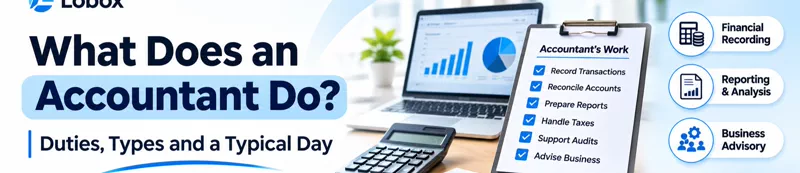
- Recording transactions. Entering sales, purchases, payroll and expenses in the general ledger, or reviewing entries that software has posted automatically.
- Reconciling accounts. Checking that the ledger matches bank statements, credit card statements and supplier records, then finding out why it does not.
- Month-end and year-end close. Making adjustments, accruals and corrections so the books are complete for the period.
- Preparing financial statements. Balance sheet, income statement and cash flow statement.
- Tax work. Preparing returns, estimating tax due and keeping records ready for tax authorities.
- Budgets and forecasts. Comparing actual spending to the plan and explaining the gaps.
- Supporting audits. Pulling documents and answering auditors' questions.
- Advising. Telling a manager or business owner what the numbers mean before they hire, buy or cut costs.
Accountant vs bookkeeper vs auditor
These three roles overlap, which is why people mix them up. The simplest way to separate them is by what each one is responsible for.

In small businesses, one person often does both the bookkeeping and the accounting. In larger companies, the roles are split.
Types of accountants and what they do
Accounting is several jobs under one title. Here are the main paths you will see in job listings.

If you are still deciding, public accounting and corporate (management) accounting are the two most common starting points.
What accountants do at each career level
Your duties change a lot as you gain experience. Early on you do the detailed work. Later you review other people's work and spend more time explaining numbers to leadership.

What does a staff accountant do?
A staff accountant handles the detailed, recurring work that keeps the books accurate. That includes posting journal entries, reconciling bank and balance sheet accounts, processing or reviewing invoices, and completing assigned month-end tasks. It is the most common entry-level accounting job and where most people learn how a company's books really work.
Senior accountant job duties
A senior accountant does fewer routine entries and more checking. Typical duties include reviewing staff reconciliations, preparing financial statements, handling complex transactions such as accruals and fixed assets, preparing audit schedules and training newer team members. Many seniors also improve processes, such as cutting days off the month-end close.
A sample week for a staff accountant
This is an illustration of how a week near month-end often looks in a corporate accounting team. Your week will vary by employer.

In mid-month weeks, the pace is usually calmer. That is when accountants work on projects, clean up old balances or help with budgets.
What is busy season really like?
Workload in accounting comes in waves. In public accounting, the busiest period is usually the run-up to the main tax filing deadline and year-end audits, when longer hours are common. In corporate roles, the pressure is shorter and more regular: a few intense days at every month-end close, and a heavier stretch at year-end.
If you want steady, predictable hours, ask about busy season and month-end expectations in every interview. Answers vary a lot between employers.
Where do accountants work?
Accountants work almost everywhere money moves. The most common employers are:
- Public accounting firms, from small local practices to large international firms
- Companies in every industry, in their finance or accounting department
- Government agencies at federal, state and local level
- Nonprofits, schools and hospitals
- Self-employment, serving small businesses and individuals
Many roles are now hybrid or remote, especially after the first year or two. Entry-level roles are more often in the office, because that is where you learn fastest.
Skills and tools accountants use
The job needs more than being good with numbers. The skills employers ask for most often fall into two groups.
Hard skills
- Spreadsheets: lookups, pivot tables, formulas and tidy formatting
- Accounting software, such as QuickBooks or Xero in small businesses and larger ERP systems such as NetSuite, SAP or Oracle in bigger companies
- Understanding of accounting principles (GAAP in the US)
- Reconciliation and attention to detail
Soft skills
- Explaining numbers in plain language to people who are not accountants
- Chasing information from other teams politely and persistently
- Managing deadlines when several closes or clients overlap
- Honesty and judgment, because you often see sensitive information
If you are building a resume for accounting roles, our guide to the best skills to put on a resume shows how to list these so recruiters notice them.
Do you need a CPA to be an accountant?
No. Many accountants work without a CPA license, especially in corporate roles. A bachelor's degree in accounting or a related field is the usual entry requirement. A CPA becomes important if you want to sign audit opinions, move up in public accounting or reach senior finance roles. Requirements are set by each state.
Most states require a set amount of college credit, passing the CPA exam and relevant work experience before you can be licensed. Other certifications, such as the CMA for management accountants, can also help depending on the path you choose.
How much do accountants earn?
Pay depends on location, industry, level and certifications. For current US figures, check the Accountants and Auditors page in the BLS Occupational Outlook Handbook, which lists median pay and the job outlook. For pay in your city, compare recent job listings in your area.
Is accounting the right career for you?
Accounting tends to suit people who enjoy order, finishing tasks completely and finding out why two numbers do not match. It is a weaker fit if you dislike routine or deadlines. A quick self-test helps.
Answer honestly:
- Do you get satisfaction from making something add up exactly?
- Can you handle a few weeks a year of long hours if the rest of the year is steadier?
- Are you comfortable asking colleagues for missing documents, more than once?
- Would you enjoy explaining numbers to people who find them confusing?
- Are you willing to keep learning as tax rules and software change?
If you said yes to most, accounting is worth a closer look. The best next step is to speak with people already doing the job. Two or three short conversations with working accountants will tell you more about busy season, culture and career paths than any article. You can find and connect with finance and accounting professionals on Lobox and ask them what their week actually looks like.
How to get started in accounting
- Pick a starting path. Public accounting if you want fast learning and a clear route to a CPA. Corporate accounting if you want steadier hours.
- Get the basics. A degree in accounting is the standard route. Career changers often start with accounting coursework or an entry-level role such as accounts payable or bookkeeping.
- Build practical skills. Get comfortable with spreadsheets and at least one accounting software package.
- Write a targeted resume. Coming from another field? Our career change resume guide shows how to present your past experience for a new role.
- Search in the right places. Use specialist and general job search websites, and build connections with accountants and finance recruiters.
- Prepare for interviews. Expect questions on reconciliations, attention to detail and how you handle deadlines. Our job interview tips cover the basics.
Accounting is one of many careers we explain in plain terms. If you are weighing it against tech, see what a software engineer does day to day.
Ready to take the next step?
If accounting sounds like a fit, start building your network now. Join Lobox to connect with accountants, finance professionals and recruiters, and keep an eye on accounting roles that match your level.
Already work in accounting? Share what your typical week looks like in the comments. Real answers help people decide.
FAQ
1.What does an accountant do for a small business?
For a small business, an accountant usually keeps the books accurate, prepares tax returns, files on time and explains how the business is doing. Many also help with budgets, payroll questions and decisions such as whether you can afford to hire. Some owners use an accountant monthly, others only at tax time.
2. Is being an accountant stressful?
It can be, mostly around deadlines. Month-end close, year-end and tax season bring pressure and sometimes long hours. Outside those periods, many accountants describe the work as steady and predictable. Stress levels vary a lot by employer, so ask about busy season and team size before you accept an offer.
3. What is the difference between an accountant and a CPA?
An accountant is anyone working in accounting. A CPA is an accountant who has met their state's education and experience rules and passed the CPA exam. Only licensed CPAs can sign audit opinions, and the license often helps with promotion in public accounting and senior finance roles.
4. Do accountants only work with taxes?
No. Tax is one specialty. Many accountants never prepare a tax return. They work on monthly closes, financial statements, budgets, cost analysis, audits or fraud investigations. If tax work does not appeal to you, management accounting, internal audit or corporate accounting are common alternatives.
5. Can I become an accountant without an accounting degree?
Yes, though the path is longer. Career changers often start in accounts payable, bookkeeping or an accounting assistant role, take accounting courses, and move up with experience. A CPA license has formal education requirements, so check your state board's rules if that is your long-term goal.
6. What does a staff accountant do in their first year?
In the first year, a staff accountant mostly learns the company's close process. Expect reconciliations, journal entries, invoice reviews and supporting the senior accountant. You will make corrections, learn the software and gradually take ownership of a set of accounts each month.