

Nov. 25, 2026
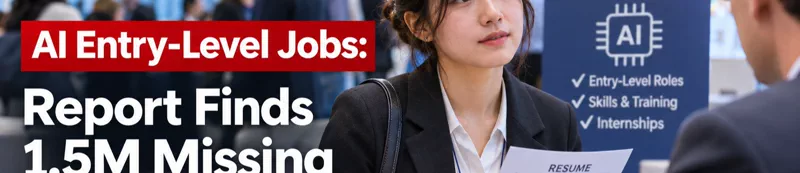
AI Entry-Level Jobs: Report Finds 1.5M Missing White-Collar Roles
Industries that use AI the most are hiring fewer beginners, according to a new report from the Burning Glass Institute and RAISE US released on Monday. The report, called "Fewer Rungs, New Bridges," finds that white-collar industries now employ about 1.5 million fewer people than pre-pandemic trends would predict.
But the story is not mass layoffs. In the authors' words, the missing workers "aren't being laid off; they're simply not being hired in the first place."

What the report found about entry-level hiring
The researchers looked at finance, insurance, information and professional services. Together these sectors employed 31.9 million people in August 2026, about 1.5 million short of where their growth from 2005 to 2019 would have put them.
Hiring has slowed in these industries even as their output keeps growing. In the most AI-intensive industries, the share of job postings open to people with three years of experience or less was 3% to 8% below its 2021-2026 average in the year ending June 2026. Across the wider economy, that share barely moved.
The authors are careful about cause. The 1.5 million figure is a net number that also reflects other forces, such as offshoring and older technology. They treat AI as one of several likely factors, not the only one.
Which jobs are shrinking, and which are growing?
The split is the most useful part of the report. Between 2023 and 2025, occupations most at risk of automation lost about 820,000 jobs. Over the same period, occupations where AI helps workers do more gained about 1.4 million.
Office and administrative support took the biggest hit, along with clerical and customer service roles.
Workers without a four-year degree are the most exposed. They hold 80% of the jobs most likely to be automated, compared with 64% of all jobs. And most proven paths from no-degree jobs into better-paid careers still end in roles that usually require a degree.
Gina Raimondo, former U.S. Commerce Secretary and co-chair and CEO of RAISE US, called the findings a wake-up call for leaders "from Washington to Silicon Valley."
What this means if you're looking for your first job
The report's message for job seekers is that the old route, where you learn on the job in a junior role, is getting harder to find. The answer is to bring some of that experience with you.
The report points to a few ways to do that:
- Get real-world experience early. Co-ops, apprenticeships and employer-designed projects can stand in for the training junior jobs used to provide.
- Learn to use AI on the job. The report urges more focus on applied AI skills, since roles where AI assists workers are the ones growing.
- Build the human skills. The researchers say communication and collaboration are becoming core skills across the economy, and they help people move into a wider range of jobs.
- There is some good news for career changers. Looking at 2,741 moves into jobs that employers struggle to fill, the researchers found AI could help newcomers close about 31% of the skills gap. In those cases, AI can work as a bridge into a new field rather than a barrier.
Why employers should pay attention
Fewer junior hires today means fewer experienced workers and future managers later. If AI takes over the tasks that once trained new staff, companies will need to find other ways to grow their own talent, through apprenticeships, rotations or structured projects.
The report adds to a growing body of research on AI and early careers, including a Business Roundtable and Burning Glass briefing published in September. The next official signal is the November jobs report from the Bureau of Labor Statistics, due in early December. Watch for hiring trends in finance, professional services and office support roles.