
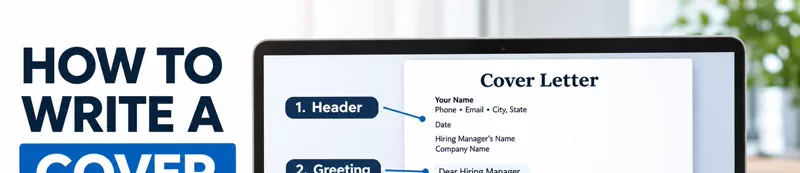


To write a cover letter, pick the three things the job post asks for most, then show in under a page how you've already done them. Open with the role and your strongest match, back it up with one or two specific examples, and close by asking for a conversation.
That's the whole method. Below you'll find how to write a cover letter for a job step by step, a template you can copy, two examples, and a checklist to run before you hit send.
What is a cover letter for a job?
A cover letter is a short letter, usually one page, that you send with your resume when you apply for a job. Your resume lists what you've done. The cover letter explains why that experience fits this specific role and this specific company, in your own voice. It's your chance to connect the dots for the hiring manager.
Not every employer reads them, and some applications make them optional. Write one anyway when the job matters to you. A tailored letter is one of the few parts of an application where you control the story.
How to write a cover letter in 6 steps
Step 1: Pull three requirements from the job post
Before you write a word, open the job description and highlight what comes up most. Look at the first few bullet points, anything repeated, and anything marked "required".
Pick the top three. For each, note one moment from your work where you did that thing and what happened as a result. Those three pairs are the raw material for your whole letter.

Step 2: Write the header
Keep it simple and match the look of your resume. Include:
• Your full name
• Phone number and professional email
• City and state (a full street address is optional)
• A link to your portfolio or professional profile, if relevant
• The date
• The hiring manager's name, title and company
If you're pasting the letter into an online form or an email, skip the date and the employer's address block. Put your contact details under your signature instead.
Step 3: Address it to a real person
The best way to address a cover letter is by name: "Dear Priya Sharma" or "Dear Ms. Sharma". If you don't know their title or pronouns, the full name is the safe choice.
To find the name, check the job post, the company's team page, or professional networks. If you still can't find it, use a specific team greeting:
• Dear Hiring Manager
• Dear Marketing Team
• Dear [Company Name] Recruiting Team
Avoid "To whom it may concern". It reads like a form letter, which is the opposite of what you want.
Step 4: Open with the job and your strongest match
Your first two sentences decide whether the rest gets read. Name the role, then lead with the single best reason you fit. Skip "My name is" and "I am writing to apply". They already know.
Weak: "I am writing to express my interest in the Account Manager position at your company."
Better: "I'm applying for the Account Manager role at Brightline because I've spent three years doing exactly what your post describes: keeping a large book of B2B clients happy and renewing."
If someone referred you, mention them here. It's the strongest opener you can have.
Step 5: Prove it in one or two body paragraphs
This is where your three pairs from Step 1 go. Write one short paragraph per point, or group them into two paragraphs if they're related.
Use this simple pattern for each one:
1. The need: what the company wants
2. The proof: what you did, with a number or clear result if you have one
3. The link: how that helps them in this role
Don't repeat your resume line by line. Pick the stories behind the bullet points. Add one sentence about why this company specifically, based on something real: a product you use, a recent launch, or how they describe their team.
Step 6: End with a clear next step
To end a cover letter well, sum up your fit in one line, thank them, and invite a conversation. Then sign off.
"I'd welcome the chance to talk about how I could help your team keep renewals on track. Thank you for your time, and I look forward to hearing from you."
Good sign-offs: "Best regards", "Kind regards", "Sincerely". Then your full name. Avoid casual closers like "Cheers" unless the company's tone is clearly informal.
Cover letter template (copy and paste)
Copy this into your document, then replace every bracket. Delete any line that doesn't apply.
[Your Name]
[Phone] | [Email] | [City, State] | [Portfolio or profile link]
[Date]
[Hiring Manager Name]
[Title]
[Company]
Dear [Hiring Manager Name],
I'm applying for the [Job Title] role at [Company] because [one-line reason you fit, tied to the top requirement in the job post].
In my role as [your current or last title] at [company], I [specific achievement linked to requirement 1, with a result]. I also [achievement linked to requirement 2], which [result or benefit].
What draws me to [Company] is [something specific: product, mission, recent news, team culture]. I'd bring [requirement 3 skill], shown by [short proof], to help your team [goal from the job post].
I'd welcome the chance to talk about how I can help with [main priority of the role]. Thank you for your time and consideration.
Best regards,
[Your Name]
Cover letter examples
Both examples are fictional and written for this guide. Use them to check your structure and tone, not to copy word for word.
Example 1: Entry-level (customer support role)
Dear Jordan Lee,
I'm applying for the Customer Support Associate role at Nestwell. I spent two years answering customer questions part-time while finishing my degree, and I enjoy turning a frustrated caller into a satisfied one.
At the campus bookstore, I handled phone and email queries during the busiest weeks of each semester. I wrote a short FAQ for common order problems, which my manager shared with the whole team. Your post mentions documenting solutions for the knowledge base, and that's the part of the job I'm most excited about.
I've used Nestwell's app to manage my own rental, so I know the product from the customer's side. I'd love to bring that view to your support team.
Thank you for considering my application. I'd be glad to talk whenever suits you.
Kind regards, Sam Ortiz
Example 2: Experienced (operations coordinator)
Dear Hiring Manager,
I'm applying for the Operations Coordinator position at Fieldstone Logistics. For the past five years, I've run scheduling and vendor coordination for a regional distribution team, which lines up closely with what your post describes.
In my current role, I moved our delivery scheduling from spreadsheets to a shared planning tool and trained eight dispatchers to use it. Missed delivery windows dropped noticeably in the first quarter. I also manage relationships with 20+ vendors, including contract renewals and performance reviews.
Fieldstone's expansion into two new states will need tight coordination between warehouses and carriers. That's the work I do every day, and I'd like to do it for a team that's growing.
I'd welcome a conversation about how I could support your operations team. Thank you for your time.
Best regards, Dana Mitchell
How long should a cover letter be?
A cover letter should fit on one page, which usually means three to four short paragraphs and roughly 250 to 400 words. If you're pasting it into an email or an application form, aim for the shorter end. Hiring managers skim, so every sentence should earn its place.
If yours runs long, cut in this order: anything that repeats your resume, general claims without proof ("I'm a hard worker"), and any second example for the same skill.
Cover letter vs resume: what's the difference?
A resume is a structured record of your experience, skills and education. A cover letter is a short, personal argument for why that experience fits one specific job. You can reuse a resume across similar roles, but every cover letter should be written for the job in front of you.

Want your resume to match the letter? Our guides on the best skills to put on a resume and resume summary examples help you line up both documents.
How to tailor your cover letter in 5 minutes
You don't need to start from scratch for every application. Keep a master version built from the template above, then change these four things each time:
1. The greeting. Find a real name if you can.
2. The opening line. Swap in the job title and the top requirement from this post.
3. One body example. Pick the story that best matches this role's main need.
4. The "why this company" sentence. Make it specific to them.
Finding a real name is often the hardest part. On Lobox you can connect with professionals and recruiters, which makes it easier to find out who's hiring for a team before you apply.
Should you use AI to write your cover letter?
AI tools can help you get a first draft down or tighten a paragraph that runs long. The risk is a letter that sounds like everyone else's: generic praise for the company, vague claims and no real examples.
If you use AI, feed it your three requirement-and-proof pairs from Step 1 and the job post. Then rewrite the result in your own words, check every fact, and remove anything you couldn't back up in an interview.
Common cover letter mistakes to avoid
• Sending the same letter to every employer
• Opening with "My name is" or "I am writing to apply"
• Repeating your resume instead of telling the story behind it
• Talking only about what you want, not what you'll bring
• Getting the company name or job title wrong (it happens more than you'd think)
• Going over one page
Checklist before you send
• Addressed to a named person, or a specific team
• Job title and company name are correct
• Opening line names the role and your strongest match
• At least one example with a clear result
• One sentence on why this company
• Under one page
• Read out loud once for typos and awkward phrasing
• Saved as PDF unless the employer asked for another format, with a clear file name (FirstName-LastName-Cover-Letter.pdf)
Once your letter is ready, the interview is the next step. Our job interview tips cover how to prepare.
Ready to put your cover letter to work?
A good cover letter only helps if it reaches the right job. Join Lobox to find jobs that match your experience, connect with recruiters, and apply with a letter that's written for the role.
FAQ
Do I really need a cover letter?
If the application asks for one, yes. If it's optional, send one for any job you genuinely want, because it lets you explain your fit in a way a resume can't. Skip it only when the application system has no place to add one, or the employer says not to.
What should a cover letter include?
Your contact details, a greeting addressed to a person or team, an opening that names the role and your strongest match, one or two paragraphs of proof tied to the job post, a line on why this company, and a closing that invites a conversation. Keep it all on one page.
How do you start a cover letter?
Start with the job title and the single best reason you fit, in one or two sentences. If someone referred you, name them first. Avoid stock openers like "My name is" or "I am writing to apply", because the reader already knows who you are and why the letter exists.
Is it OK to write "Dear Hiring Manager"?
Yes, when you can't find a name. It's polite and widely accepted. A named greeting is better, so spend a few minutes checking the job post, the company website and professional networks first. A specific team greeting, like "Dear Marketing Team", is a good middle ground.
Should my cover letter be a PDF or Word file?
Use PDF unless the employer asks for something else. A PDF keeps your formatting the same on every screen. If the application asks for a Word document, or you're pasting into a text box, follow those instructions instead. Name the file clearly with your name and "Cover Letter".
Can I use the same cover letter for every job?
You can reuse the structure, but not the letter itself. Keep a master version, then change the greeting, opening line, main example and the "why this company" sentence for each application. A generic letter is easy to spot and usually does more harm than sending none.