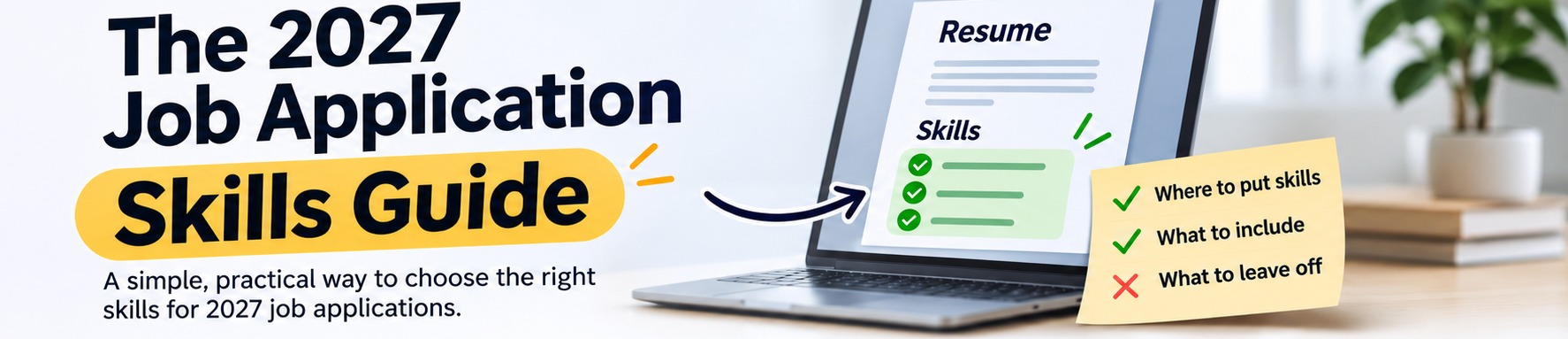

The best skills to put on a resume are the ones the job post asks for and you can back up with a real result. Use a mix of hard skills (tools, methods, licenses) and soft skills (how you work with people and problems). List the most relevant ones in a skills section, then prove the top three or four in your work experience. Below you'll find a simple way to choose your skills for 2027 job applications, examples for 12 common jobs, where each skill should go on the page, and which skills to leave off.
Hard skills vs soft skills: what's the difference?
Hard skills are specific, teachable abilities you can test or certify, like SQL, bookkeeping or forklift operation. Soft skills describe how you work, like communication, problem solving and staying calm under pressure. Recruiters want both, but hard skills usually decide if you're qualified, and soft skills help decide who gets the offer.
Most good skills for a resume fall into one of these groups:

There's a third group worth knowing: transferable skills. These are skills that move with you from one job or industry to another, like project management or client communication. If you're changing careers, they do most of the heavy lifting. Our guide to [transferable skills for a career change] covers them in depth.
How do you choose which skills to put on your resume?
Start with the job post, not your own list. Pull out every skill the employer mentions, keep only the ones you can prove with an example, then rank them by how often and how early they appear in the post. The skills near the top of that list go in your skills section and your strongest bullets.
Here's how to do that in about 20 minutes.
Step 1. Pull skills from the job post. Copy the post into a document. Highlight every tool, method, certification and soft skill it names. Pay extra attention to anything under "requirements" or repeated more than once.
Step 2. Compare several posts for the same role. Open three to five similar job posts. Skills that show up in most of them are the core skills for that role. Skills that appear once are nice extras.
Step 3. Check what you can prove. For each skill, ask yourself: can I point to a project, task or result where I used this? If the answer is no, leave it off or move it to a "currently learning" line.
Step 4. Use the employer's wording. If the post says "customer relationship management", don't write "client care". Matching the exact words helps with applicant tracking systems (ATS) and with recruiters who scan for those terms.
Step 5. Rank and cut. Put the most requested skills first. Six to ten skills is a sensible range for most skills sections. A list of 30 tells the recruiter you didn't choose.
If you're not sure which skills matter most in a field, ask someone already doing the job. A former colleague, an alumni contact or someone in a professional group for your field can usually tell you in one short conversation which skills hiring managers actually check.
Skills to put on a resume, by job type
The right skills depend on the job. Below are examples for 12 common roles, each with hard skills, soft skills and one sample bullet showing how to prove a skill. The numbers in the sample bullets are examples only. Use your own real results.
Customer service representativ
• Hard skills: CRM software (Zendesk, Salesforce Service Cloud), ticket management, live chat and phone support, order and returns processing
• Soft skills: active listening, patience, conflict resolution, clear written communication
• Sample bullet: "Handled 40 to 60 support tickets a day in Zendesk and kept customer satisfaction scores above team target for six straight months."
Sales representative
• Hard skills: CRM pipeline management, lead qualification, cold calling and email outreach, product demos, contract negotiation
• Soft skills: persuasion, resilience, relationship building, listening for needs
• Sample bullet: "Built a pipeline from zero to 80 qualified leads in my first quarter using email outreach and follow-up calls."
Retail associate
• Hard skills: POS systems, cash handling, inventory counts, visual merchandising, stock replenishment
• Soft skills: friendliness, reliability, working under pressure, teamwork during peak hours
• Sample bullet: "Trained four new hires on the POS system and opening checklist during the holiday season."
Administrative assistant
• Hard skills: Microsoft 365 or Google Workspace, calendar management, travel booking, data entry, basic bookkeeping
• Soft skills: organization, discretion, attention to detail, prioritizing competing requests
• Sample bullet: "Managed calendars for three senior managers and cut scheduling conflicts by setting up shared booking rules."
Marketing coordinator
• Hard skills: Google Analytics, email marketing tools, social media scheduling, SEO basics, content writing, Canva or Adobe Express
• Soft skills: creativity, deadline management, collaboration with sales and design teams
• Sample bullet: "Rewrote our monthly newsletter and raised the open rate from 18% to 26% over four sends."
Software developer
• Hard skills: the languages in the post (for example JavaScript, Python, Java), Git, REST APIs, automated testing, SQL, cloud platforms
• Soft skills: problem solving, code review communication, estimating work, learning new tools quickly
• Sample bullet: "Rebuilt the checkout API in Node.js, cutting average response time by half and removing a recurring timeout bug."
Data analyst
• Hard skills: SQL, Excel (pivot tables, lookups), Python or R, Tableau or Power BI, data cleaning, basic statistics
• Soft skills: curiosity, explaining findings to non-technical people, accuracy
• Sample bullet: "Built a weekly Power BI sales dashboard that replaced three manual spreadsheets used by the regional team."
Project manager
• Hard skills: project planning, budgeting, risk tracking, Agile or Scrum, tools like Jira, Asana or MS Project, PMP or similar certification
• Soft skills: leadership, stakeholder communication, negotiation, decision making
• Sample bullet: "Led a team of 9 through a CRM migration, delivered two weeks early and within the approved budget."
Registered nurse
• Hard skills: patient assessment, medication administration, IV therapy, electronic health records (such as Epic or Cerner), BLS and ACLS certification, state RN license
• Soft skills: empathy, calm under pressure, clear handoffs, teamwork across shifts
• Sample bullet: "Cared for 5 to 6 patients per shift on a busy med-surg unit and trained two new graduate nurses on charting in Epic."
Teacher
• Hard skills: lesson planning, curriculum design, classroom management, assessment and grading, learning platforms like Google Classroom, state teaching certification
• Soft skills: patience, public speaking, adapting to different learners, parent communication
• Sample bullet: "Designed a new reading intervention plan for 12 students and moved most of them up one reading level by year end."
Accountant
• Hard skills: GAAP, account reconciliation, month-end close, accounts payable and receivable, QuickBooks or NetSuite, advanced Excel, CPA (if held)
• Soft skills: accuracy, confidentiality, meeting deadlines, explaining numbers to managers
• Sample bullet: "Shortened month-end close from 10 days to 6 by standardizing reconciliation templates."
Warehouse and logistics associate
• Hard skills: forklift operation (with certification), warehouse management systems, picking and packing, shipping and receiving, inventory scanning
• Soft skills: reliability, safety awareness, physical stamina, teamwork
• Sample bullet: "Kept a 99% pick accuracy rate over 12 months while working the highest-volume shift."
Don't see your job? Use the method in the section above. Three to five job posts for your role will tell you more than any generic list.
Best skills to have on a resume in 2027 (for any job)
Some skills are useful in almost every role. These are worth including when the job post mentions them or when you have a clear example:
• Communication: writing clear emails, presenting, explaining complex things simply
• Problem solving: spotting issues early and fixing them without being asked
• Teamwork: working well across roles, shifts or departments
• Time management: handling deadlines and competing priorities
• Adaptability: picking up new tools, processes or responsibilities quickly
• Attention to detail: catching errors before they cost money or time
• Computer skills: named tools, not "computer literate" (for example "Excel: pivot tables and VLOOKUP")
The catch: every applicant lists these. On their own they don't help you stand out. What helps is showing them in action, which is covered below.
Where should you list skills on a resume?
Put skills in three places: a dedicated skills section for quick scanning, your summary for the two or three that define you, and your work experience bullets for proof. Recruiters judge your skills and resume experience together, so a skill that only appears in the list carries much less weight than one backed by a bullet.
1. The skills section. Keep it short and grouped. A simple format:
SKILLS
Technical: SQL, Excel (pivot tables, Power Query), Tableau, Python (pandas)
Certifications: Google Data Analytics Certificate
Working style: stakeholder reporting, process documentation, cross-team collaboration
Place it near the top if you're entry level, changing careers or applying for technical roles. Put it after your experience if your job history is strong and directly relevant.
2. The resume summary. Name the two or three skills that matter most for this job. Example: "Customer support lead with five years in SaaS, strong in Zendesk, team training and handling escalations."
3. Work experience bullets. This is where skills become believable. Each key skill from your list should appear in at least one bullet with a result.
If you're changing careers, lead with transferable skills and pick a format that puts them first. Our [career change resume guide] walks through the formats and examples.
How to prove your skills with results
A skill on a list is a claim. A skill in a bullet with a result is evidence. Every skill for a resume should pass one test: could you tell a two-minute story about using it if the interviewer asked?
Use this simple formula for each bullet:
Action verb + what you did (the skill) + the result
- Weak (skill only)
- Strong (skill + proof)
- Strong communication skills
- Wrote the onboarding guide now used by every new hire in the support team
- Proficient in Excel
- Built an Excel tracker that cut weekly reporting time from 3 hours to 45 minutes
- Team player
- Covered two open shifts a week for three months while the team was short-staffed
- Leadership
- Led a 4-person team through a store remodel without closing a single day
- Problem solver
- Found a billing error affecting 200 accounts and worked with finance to refund customers
No hard numbers? Use scale (how many people, accounts or projects), frequency (daily, weekly) or outcome (approved, adopted, renewed). "Trained every new hire on the returns process" is still proof, even without a percentage.
Skills to leave off your resume
Not every skill earns its space. Cut these:
• Skills you can't back up. If an interviewer asks about it and you freeze, it hurts more than it helps.
• Outdated or assumed basics. "Email", "internet browsing" or "Microsoft Word" for an office role. Recruiters assume them.
• Skill bars and percentages. "Python 80%" means nothing to a reader. 80% of what, compared to whom?
• Unrelated skills. Your latte art probably doesn't belong on a data analyst resume, unless the job is in hospitality.
• Buzzwords with no proof. "Results-driven self-starter" says nothing. Show the result instead.
• Everything at once. A long list buries the skills that actually match the job.
A quick final check: read your skills section next to the job post. If a recruiter compared them side by side, would the match be obvious within 10 seconds?
Final check before you send your resume
Run through this list once your skills section is written:
• You have six to ten skills, not 30.
• Your top three or four skills each appear in at least one experience bullet with a result.
• You used the employer's wording, not your own synonyms.
• There's nothing on the list you couldn't talk about for two minutes in an interview.
• Your online professional profiles show the same skills, so a recruiter who looks you up sees a consistent story.
4. FAQ
How many skills should I put on my resume?
For most roles, six to ten skills in the skills section is enough. That's long enough to cover what the job post asks for and short enough that a recruiter can scan it in seconds. Choose quality over quantity. Each skill you list should match the job and be backed by at least one example somewhere in your work experience.
What skills should I put on a resume with no experience?
Use skills from school, volunteering, part-time work, personal projects and online courses. Tools you've learned (Excel, Canva, a programming language) count as hard skills. Group projects, club roles and customer-facing jobs show soft skills like teamwork and reliability. Put your skills section near the top so it carries more weight than a short job history.
What skills do employers look for most?
It depends on the role, so the job post is your best guide. Across most jobs, employers ask for communication, problem solving, teamwork and reliability, plus the specific tools and qualifications for that field. Compare three to five posts for the role you want. Skills that appear in most of them are the ones to put first on your resume.
Should I put soft skills on my resume?
Yes, but show them rather than just naming them. Listing "teamwork" or "communication" adds little because almost every applicant does it. Put one or two soft skills in your summary if the job stresses them, then prove them in your experience bullets, for example by describing a team you trained or a conflict you resolved with a customer.
Where do skills go on a resume?
Skills belong in three places: a short skills section, your resume summary and your work experience bullets. The skills section helps recruiters and ATS software scan quickly. The summary highlights your top two or three. The bullets prove them with results. Entry-level applicants and career changers usually place the skills section near the top of the page.
Can I list skills I'm still learning?
Yes, as long as you're honest about the level. Add a line such as "Currently learning: Python (online course, in progress)" rather than mixing it in with skills you use daily. Only include it if it's relevant to the job, and be ready to explain what you've learned so far if an interviewer asks.