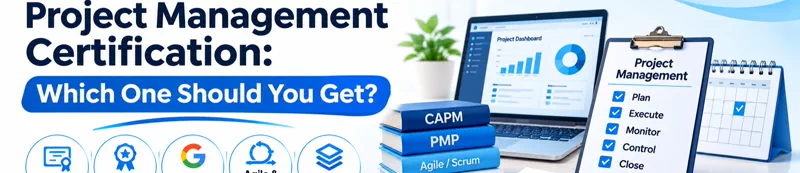

The right project management certification depends on how much experience you have. With no experience, start with the CAPM or the Google Project Management Certificate. With three or more years of leading projects, the PMP is the one most employers recognize. If you work on agile or software teams, add an agile or Scrum certification.
Below you will find a quick decision table, what each certification requires, what it costs, and when a certification is worth the time and money.
Which project management certification is right for you?
Choose based on your experience today, not the job you want in five years. Beginners should pick an entry-level credential such as the CAPM or Google certificate. Experienced project leaders should aim for the PMP. People on agile teams get more from an agile or Scrum certification. You can add the next level later.

The main project management certifications compared

Associate in project management certification (CAPM)
The Certified Associate in Project Management (CAPM) is PMI's entry-level certification. It needs no project experience. You need a secondary school diploma (or equivalent) and 23 hours of project management education completed before the exam. It covers traditional project management, agile basics and business analysis.
The CAPM suits graduates, coordinators and career changers who want a credential that hiring managers recognize. It also counts toward the PMP's training requirement later, so the effort is not wasted when you move up.
To keep the CAPM active, you earn 15 professional development units (PDUs) every three years. PDUs are hours spent learning, teaching or volunteering in the field.
PMP certification: the one most employers ask for
The Project Management Professional (PMP) is for people who already lead projects. PMI requires one of these:
- A four-year degree plus 36 months of experience leading projects, plus 35 hours of project management training or an active CAPM
- A high school or secondary diploma plus 60 months of experience leading projects, plus 35 hours of training or an active CAPM
The experience must fall within the past eight years. "Leading projects" does not need the job title project manager. If you planned, coordinated and delivered projects as a team lead, engineer or marketer, that experience can count. You list each project separately in the application.
The PMP is the certification you will see most often in project manager job listings. Check five or ten listings for your target role and city to confirm this before you commit.
Google project management certification
The Google Project Management Certificate is an online, self-paced program on Coursera. It needs no degree or experience. It covers planning, budgets, risk, stakeholder management and agile basics, with hands-on practice.
It is the cheapest and fastest way to learn the basics, which makes it a good first step for career changers. It is a certificate of completion, not a professional certification like the PMP, so treat it as proof of learning rather than proof of experience. Google says the program is accredited by PMI [VERIFY: whether it counts toward the CAPM education hours].
Project manager certificate online: other options
If you want a project manager certificate online, you have more choices than the big names:
- University certificate programs. Many universities offer online project management certificates through their continuing education departments. These carry a school's name and often count as training hours.
- PMI Authorized Training Partners. Online PMP and CAPM prep courses that cover the training hours PMI requires.
- Course platforms. Coursera, edX and similar sites host courses from universities and companies.
Before you pay, check that the course states how many contact hours it provides and whether PMI accepts them.
Project management certification for agile teams
If your team works in sprints, an agile project management certification is often more useful than the PMP. The common options are:
- Certified ScrumMaster (CSM) from Scrum Alliance, usually earned through a short course
- Professional Scrum Master (PSM) from Scrum.org, earned by passing an assessment
- PMI Agile Certified Practitioner (PMI-ACP), which requires agile project experience and suits people who already work in agile teams
For software and IT roles, agile certifications show up in job listings alongside, or instead of, the PMP.
Best IT project management certification
For IT project management, there is no single best choice. It depends on your role. A common path is CompTIA Project+ or the CAPM early on, then the PMP once you have the experience, plus a Scrum certification if you work with developers. ITIL is useful if your projects involve IT service management.
Moving into tech from another field?
Cost of project management certification
Costs vary widely, from a monthly subscription to several hundred dollars in exam fees plus training.

PMI membership lowers PMI exam fees, so compare the membership cost with the saving before you register. Ask your employer, too. Many companies pay for certifications if you can show how it helps your role.
How to get a project management certification
- Check your experience honestly. Count months spent leading projects in the last eight years. This decides whether the PMP is open to you yet.
- Pick the certification from the decision table above.
- Read the official requirements on the issuer's website (PMI, Google, Scrum Alliance, Scrum.org or PeopleCert). Requirements change, and third-party blogs go out of date.
- Complete the required training hours with a provider the issuer accepts. Keep your certificates of completion.
- Apply and schedule the exam. For PMI certifications, you apply first, then pay and book once the application is accepted.
- Study with practice exams until you are passing them comfortably.
- Add it to your resume and profiles right away, with the full name and the year earned.
While you study, talk to people who already hold the certification. Ask project managers in your industry which credential their hiring managers actually look for. You can find and connect with project managers and recruiters on Lobox and ask them directly.
Is a project management certification worth it?
It is usually worth it if it matches your stage and the jobs you are targeting. The PMP is widely requested for project manager roles. Entry-level certificates help most when you have no other proof of project skills. A certification will not replace experience, so pair it with real projects, even small ones at work or as a volunteer.
A certification is less likely to pay off if:
- The jobs you want do not mention it in their listings
- You are buying an advanced certification before you have the experience to use it
- You are collecting several entry-level certificates instead of getting hands-on practice
For salary and demand data for project managers in the US, check the BLS Occupational Outlook Handbook.
How to show your certification to employers
- Put it in a Certifications section on your resume and in your headline or summary if it is central to the role. Our guide to the best skills to put on a resume shows how to pair certifications with skills.
- Changing careers? Lead with your transferable project experience. See our career change resume guide for a format that works.
- Use the certification name as a keyword when you search on job search websites.
- Be ready to describe a real project in interviews. Our job interview tips help you prepare.
Start building your project management network
A certification gets your resume noticed. People get you hired. Join Lobox to connect with project managers, hiring managers and recruiters, and follow project management roles that fit your level.
Already certified? Share which certification helped you most, and why, in the comments.
FAQ
1.What is the easiest project management certification to get?
The Google Project Management Certificate and the CAPM are the most accessible. Neither needs project experience. The Google certificate is self-paced online learning, while the CAPM requires 23 hours of project management education and a proctored exam. If you want a credential from PMI, the CAPM is the easier route.
2. Can I get the PMP without a degree?
Yes. With a high school or secondary diploma, PMI asks for 60 months of experience leading projects within the past eight years, plus 35 hours of project management training or an active CAPM. With a four-year degree, the experience requirement drops to 36 months.
3. How long does it take to get a project management certification?
It depends on the certification and your schedule. Entry-level options such as the Google certificate or the CAPM can take a few weeks to a few months of part-time study. The PMP takes longer, because you first need years of project experience, then the training hours and exam preparation.
4. Is the Google project management certificate worth it?
It is worth it as a low-cost way to learn the basics and show initiative, especially if you are changing careers. It does not replace experience or a professional certification. Many people use it as a first step, then add the CAPM or PMP once they have more projects behind them.
5. Do project managers need a certification?
No, but it often helps. Many project managers are hired on experience alone. A certification makes it easier to pass resume screening, especially for roles where listings ask for the PMP. Check job listings in your field to see how often a certification is requested.
6. What is the difference between CAPM and PMP?
The CAPM is entry-level and needs no project experience. The PMP is for people with three to five years of experience leading projects and is the credential employers ask for most. An active CAPM also meets the PMP's 35-hour training requirement, so many people take the CAPM first.