
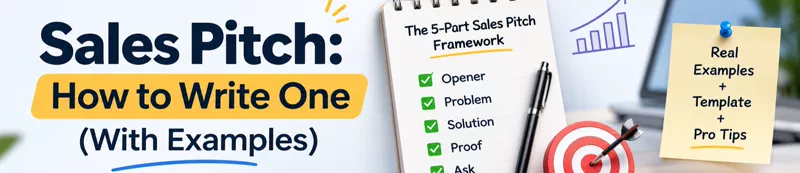

A sales pitch is a short, prepared message that shows a specific buyer how you solve a problem they already have, and asks for one clear next step. The best pitches are about the buyer, not the product. Most follow the same five parts: a relevant opener, the problem, your solution, proof that it works, and a small ask.
Below you'll find that structure, how to write a sales pitch step by step, the main types of pitch, nine sales pitch examples you can adapt, and a fill-in template.
What is a sales pitch?
A sales pitch is a planned message, spoken or written, that explains why a specific person should take the next step with you. It names a problem the buyer cares about, shows how you fix it, gives a reason to believe you, and ends with one low-effort ask, such as a 15-minute call. It is a conversation starter, not a full presentation.
That last point matters. A pitch rarely closes a deal on its own. Its job is to earn the next conversation. If your pitch tries to cover every feature, price and case study at once, the buyer has nothing left to ask about and no reason to reply.
The structure of a good sales pitch
Almost every pitch that works, whether it's a cold email or a two-minute talk at an event, follows these five parts.

Keep the proof honest. A real customer result, a named client (with permission) or a short demo beats a big claim every time. If you don't have a result yet, offer a trial or a sample instead of inventing a number.
How to write a sales pitch in 6 steps
1. Pick one buyer and one problem
A pitch written for everyone persuades no one. Before you write a word, decide who exactly you're talking to (role, company size, situation) and the single problem you'll lead with. A finance director and an office manager at the same company need different pitches, even for the same product.
2. Research before you write
Spend five minutes on the person and their company. Check their profile, recent posts, company news, job openings and the tools they already use. Job openings are a strong signal: a company hiring three new sales reps probably has an onboarding or pipeline problem worth talking about.
This is where a professional networking platform helps. When you're connected with people in your target industry, you see their updates, job changes and company news without digging. You can connect with professionals and recruiters on Lobox to keep that research close at hand.
3. Open with them, not you
Your first line decides whether the rest gets read. Skip "My name is" and "I'm reaching out because". Open with something about their world: a recent change, a shared connection, or a problem common to their role.
Weak: "Hi, I'm Sam from BrightDesk, a leading helpdesk platform." Better: "Your support team posted three job openings this month. That usually means tickets are piling up."
4. Show the change, then prove it
Buyers don't buy features. They buy the difference between how things work now and how they could work. Describe that change in one or two sentences, then back it up with one piece of proof. One strong proof point is more convincing than five weak ones.
5. Ask for one small next step
End with a single ask that's easy to say yes to. "Can we do a 15-minute call on Tuesday or Wednesday?" works better than "Let me know your thoughts" or "Would you like to buy?" Give a specific action and, where you can, a specific time.
6. Cut it, then say it out loud
Read your pitch aloud. If you run out of breath, it's too long. Delete any sentence the buyer wouldn't miss, any adjective that doesn't add meaning, and any line that talks about your company instead of their problem. Most first drafts get better when you cut them by a third.
Types of sales pitch
The structure stays the same, but the length and tone change with the channel. Here are the main types and when to use each.

The word counts and timings above are working guidelines from common sales practice, not hard rules. Test what gets replies in your market.
Sales pitch examples
Every example below is original and uses made-up companies. Swap in your own product, buyer and real proof. Where a result would go, you'll see [X] so you can add a genuine number.
Example 1: Cold email pitch (B2B software)
Subject: Faster invoice approvals at Hartley Foods
Hi Priya,
Congrats on Hartley's new Chicago site. Adding a location usually means more invoices and more people who need to approve them.
LedgerLoop routes each invoice to the right approver automatically and flags anything that's overdue. A food distributor about your size cut approval time from [X] days to [Y].
Worth a 15-minute call next Tuesday to see if it fits?
Thanks, Marcus
Why it works: the opener is specific to Priya, the problem follows naturally from it, there's one proof point and one ask. It's under 90 words.
Example 2: Cold call pitch
"Hi Daniel, it's Lena from FleetTrack. I'll be quick. I work with regional delivery companies that are losing time to missed routes and fuel overspend. Is that something your team deals with, or is it under control?"
Why it works: it's honest about being a cold call, names the problem in one line, and ends with a question so Daniel talks next. A cold call pitch should open a conversation, not deliver a monologue.
Example 3: Elevator pitch at a networking event
"I run a small bookkeeping firm for restaurants. Most owners I meet are doing their books at midnight after close, and they still get surprised at tax time. We handle the monthly books and send a one-page summary, so they always know where they stand. Who handles the numbers for your place right now?"
Why it works: it describes the buyer, the pain and the change in under 30 seconds, then turns it into a conversation. No jargon, no job title to decode.
Example 4: Follow-up pitch after no reply
Hi Priya,
Following up on my note about invoice approvals. I put together a two-minute video showing how the approval flow would look for a business with two sites like Hartley's: [link]
If timing's wrong, just say so and I'll check back next quarter.
Why it works: it adds something new (a tailored video) instead of "just checking in", and gives an easy way to say no. That respect often gets a reply.
Example 5: Social message pitch
"Hi Tom, enjoyed your post on hiring for seasonal peaks. We help retail teams schedule part-time staff without the spreadsheet chaos. No pitch deck, just curious: how are you handling the holiday rota this year?"
Why it works: it references something Tom actually wrote and asks a real question. On professional networks, a short, human message gets further than a pasted sales email.
Example 6: Problem-solution pitch in a meeting
"From what you said, the real issue isn't finding leads. It's that your reps spend most of Monday updating the CRM instead of calling. Here's what changes with us: call notes and next steps log themselves after each call. In a pilot with a team like yours, reps got back about [X] hours a week. Would it help to run a two-week pilot with three of your reps?"
Why it works: it repeats the buyer's own problem back to them first, which proves you listened, then ties the solution and the ask directly to it.
Example 7: Local small business pitch
"Hi Rachel, I'm Joe from Clearview Cleaning. I noticed your office is in the Pinewood building. We already clean two other offices there, so we're on site most evenings. I'd love to give you a free quote for weekly cleaning. Could I stop by for ten minutes on Thursday?"
Why it works: the proof is local and real (other clients in the same building), and the ask is small and concrete. Small business pitches win on trust and convenience more than features.
Example 8: Recruiter pitching a role to a passive candidate
Recruiting is selling too. A candidate who isn't job hunting needs a reason to listen, just like a buyer.
"Hi Aisha, your work leading the payments app redesign at Novabank caught my eye. I'm hiring a senior product designer for a fintech team that's rebuilding its mobile app from scratch, so you'd shape the product, not polish an old one. It's fully remote and the range is [salary range]. Open to a 15-minute chat this week, even if you're happy where you are?"
Why it works: it opens with her actual work, explains what's different about the role, shares the salary range up front and lowers the pressure with "even if you're happy where you are". If you hire, see our guide on how to hire employees for a small business for the steps around the pitch.
Example 9: Pitching yourself in a sales job interview
Many sales interviews include a version of "sell me this pen" or "pitch me our product". Interviewers aren't checking your script. They want to see if you ask questions before you pitch. The same idea applies on paper: when you write a cover letter, you're pitching yourself to one reader with one problem to solve.
"Before I tell you about the pen, can I ask how you use one day to day? ... So you sign a lot of contracts in client meetings, and a cheap pen that skips looks bad in front of a client. This one writes smoothly the first time, every time, and it looks professional on the table. If I could get you a box of ten by Friday, would that work for your team?"
Why it works: it uses the same five parts: a question as the opener, the problem in the interviewer's words, the solution, a reason to believe it, and a clear ask. For more on preparing, read our job interview tips.
Sales pitch template
Copy this, fill in the brackets and cut anything that doesn't apply.
Hi [first name],
[Opener: one specific thing about them or their company, such as a recent change, post, hire or shared connection.]
[Problem: "Teams like yours often ___ when ___."]
[Solution: "We help [type of company] [result] by [how, in plain words]."]
[Proof: one real result, client name or short demo verify.]
[Ask: "Worth a [15-minute call] on [day] or [day]?"]
[Your name]
Before you send it, check three things: is the first line about them, is there only one ask, and could you say the whole thing in under 30 seconds?
Common sales pitch mistakes and how to fix them

How long should a sales pitch be?
A sales pitch should be as short as it can be while still covering the buyer's problem, your solution, one proof point and an ask. In practice that means roughly 50 to 125 words for a cold email, about 30 seconds for a cold call opener or elevator pitch, and longer only in a booked meeting where the buyer expects detail.
If you're unsure, go shorter. A buyer who's interested will ask for more. A buyer who's overloaded will skip a long message entirely.
What makes a sales pitch effective?
An effective sales pitch is specific to one buyer, focused on a problem they already feel, honest in its proof and easy to respond to. It sounds like a person talking, not a brochure. The biggest difference between pitches that get replies and ones that don't is usually the first line: it either shows you understand the buyer or it doesn't.
Keep improving your pitch
Treat every pitch as a test. Track which openers get replies, which asks turn into meetings and where conversations stall, then rewrite. Pitches get better through repetition, not through one perfect draft.
Have a pitch line that always works for you, or one that flopped badly? Share it in the comments. We'd like to hear what's working in your market.
Whether you're building a sales career or hiring a sales team, a strong network makes every pitch easier. Join Lobox to connect with professionals, recruiters and businesses in your industry.
FAQ
1.What is an example of a sales pitch?
Here's a simple example of a sales pitch for a cold email: "Congrats on opening your second site. More locations usually mean more invoices to approve. We route each invoice to the right person automatically. Worth a 15-minute call on Tuesday?" It opens with the buyer, names a problem, offers a fix and ends with one small ask.
2.What are the 5 parts of a sales pitch?
The five parts are an opener that shows you know the buyer, the problem they face, your solution in plain words, proof that it works, and a clear ask for the next step. You can use the same five parts in an email, a phone call, an event conversation or a meeting. Only the length changes.
3.How do you start a sales pitch?
Start with something about the buyer, not yourself. A recent company change, a post they wrote, a job they're hiring for or a shared connection all work. Avoid opening with your name, your company's history or "I'm reaching out because". The first line should give them a reason to read the second.
4.How do you end a sales pitch?
End with one specific, low-effort ask, ideally with a time attached, such as "Could we do 15 minutes on Thursday?" Avoid vague endings like "let me know your thoughts", which leave the buyer to decide what to do. If it's a follow-up, give them an easy way to say not now.
5. What is the difference between a sales pitch and an elevator pitch?
An elevator pitch is one type of sales pitch. It's a 30 to 60 second spoken introduction, usually at an event or first meeting, meant to spark interest. A sales pitch is the broader term and covers cold emails, calls, follow-ups and full meeting presentations aimed at moving a specific buyer forward.
6. How do you answer "sell me this pen" in an interview?
Don't start describing the pen. Ask the interviewer a question or two about how they use pens, then pitch back to what they told you: their problem, how this pen solves it, why they can trust that, and a clear ask to close. Interviewers want to see you listen before you sell.